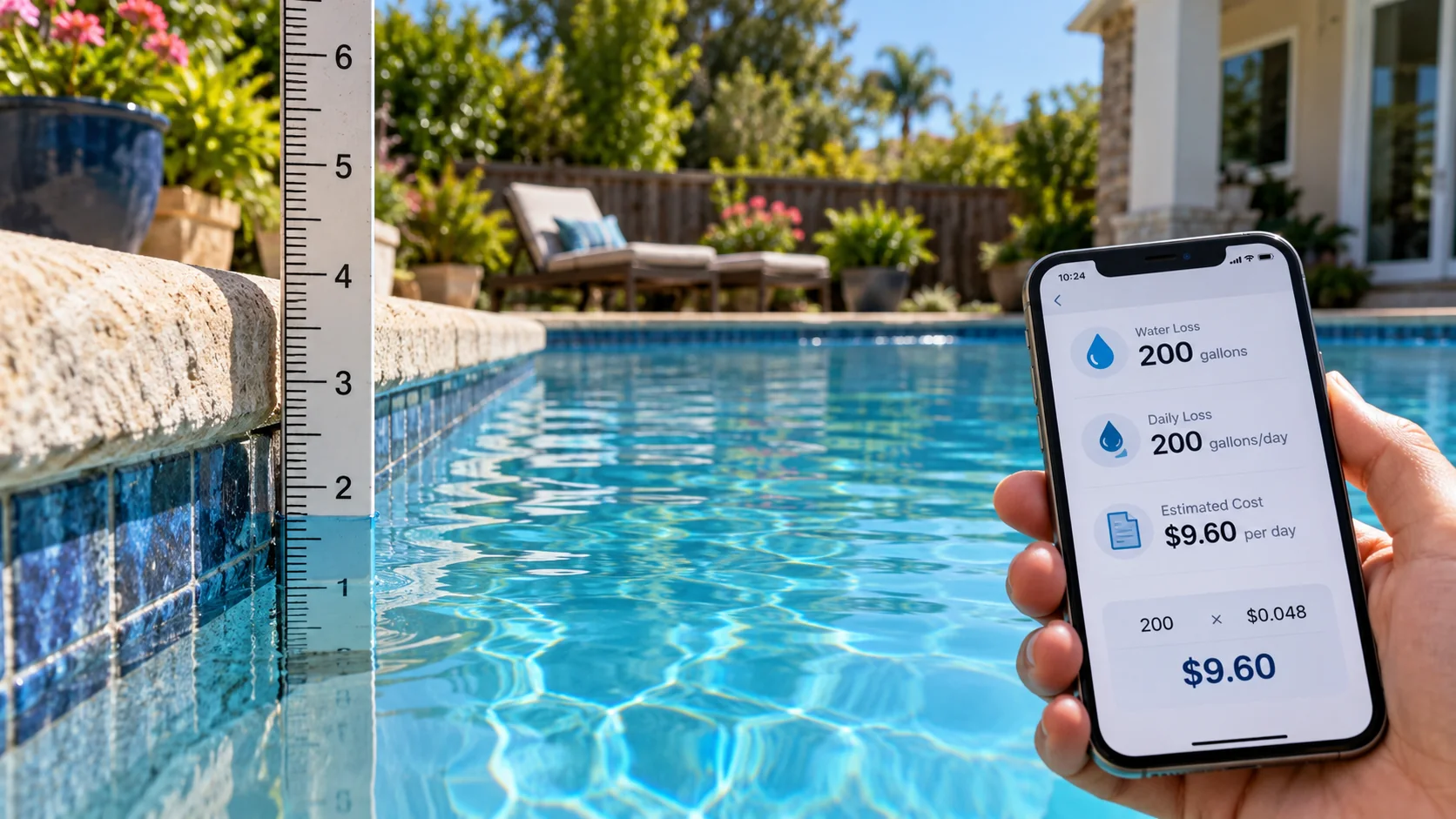
A pool leak water bill increase can be difficult to recognize when a pool refills automatically or the household uses water for several other purposes. Even a small excess drop in water level may represent a meaningful volume over several weeks. The financial effect depends on pool size, the amount of water escaping and the local utility's billing structure.
A waterline measurement is more useful when it is separated from ordinary evaporation. Wind, dry air, sunlight, warm water and swimming activity all affect water loss, so not every missing gallon indicates a leak. Once excess water loss is measured, it can be converted into an estimate of the gallons being wasted.
Plan a detection budget, then compare relevant specialists before authorizing repairs.
How Many Gallons Does a Pool Lose per Inch?
For a rectangular pool, the estimated water volume represented by a change in level depends on the surface area. One cubic foot contains approximately 7.48 US gallons, and one inch is one-twelfth of a foot. That gives a convenient conversion factor of approximately 0.623 gallons per square foot for every inch of water-level change.
Estimated gallons lost = Pool surface area (sq. ft.) × Excess loss (inches) × 0.623
For an irregularly shaped pool, the calculation requires an estimate of the water surface area. Pool depth does not enter this calculation directly because the measured change is a thin layer across the surface. However, connected spas, automatic water features and unusual geometry can make the actual volume harder to estimate.
Example: A 20 × 40 Foot Swimming Pool
Consider a rectangular pool measuring 20 feet by 40 feet. Its water surface area is approximately 800 square feet. The following table shows the volume represented by different amounts of excess daily water loss.
| Excess water loss per day | Approx. gallons per day | Approx. gallons in 30 days |
|---|---|---|
| 1/8 inch | 62 | 1,870 |
| 1/4 inch | 125 | 3,740 |
| 1/2 inch | 249 | 7,480 |
| 1 inch | 498 | 14,950 |
These numbers are mathematical examples, not normal evaporation benchmarks or claims about a particular pool. They assume the stated excess loss continues at the same rate for 30 days. Actual losses can vary with the water level, equipment operation and the condition of the defect.
How to Separate Evaporation From a Possible Leak
Before interpreting a water bill, compare the pool with water held in a bucket under similar outdoor conditions. The difference between their water-level drops is more informative than the pool drop alone. A pool that falls a quarter inch more than the control bucket has an estimated excess loss of a quarter inch for that observation period.
The PoolLeakRadar bucket test calculator helps convert those readings into estimated excess inches and gallons. Results remain estimates because measurements, pool dimensions and weather conditions affect accuracy. Repeating an uncertain test can be more useful than making a repair decision from a single observation.
How to Estimate the Financial Impact
Water utilities commonly bill for consumption using units such as 1,000 gallons or 100 cubic feet. Some also apply tiered rates, wastewater-related charges or minimum service fees. As a result, the additional cost of a pool leak depends on the actual marginal rate, not simply the total bill divided by gallons used.
For example, suppose a pool wastes approximately 3,740 gallons in 30 days and the applicable incremental water rate is $8 per 1,000 gallons. The estimated additional water charge is:
3,740 ÷ 1,000 × $8 = $29.92
This example is illustrative, not a national average or a promised bill increase. If the applicable rate differs, the result changes accordingly. Any wastewater charges, utility adjustment policies and fixed fees must be evaluated separately.
Other Costs That May Not Appear on the Water Bill
A leaking pool can also increase the need for replacement chemicals as treated water leaves the system. A heated pool may require additional energy to bring replacement water to the desired temperature. The size of these effects depends on the equipment, climate, water conditions and leak rate.
Escaping water can also affect surrounding soil or structures in some circumstances. These consequences are not inevitable, but persistent moisture near foundations, equipment or electrical systems should not be ignored. The financial comparison should therefore consider more than the price of replacement water alone.
Is Leak Detection Worth the Cost?
Professional inspection becomes a practical consideration when repeated measurements show unexplained excess water loss, especially when the amount is substantial or nearby damage is suspected. The inspection fee must be compared with the likely diagnostic work, not just one month's water bill. A properly documented diagnosis can also prevent unnecessary repairs.
Before requesting an estimate, prepare the pool dimensions, water-loss observations, pump schedule and utility rate if known. Mention whether an autofill may be concealing losses and whether the pool has an attached spa. These details help the specialist understand the system and clarify what testing may be required.
From Water-Loss Estimate to Repair Decision
The estimated gallons lost per day establish the scale of the problem, but they do not show where the water is escaping. A buried pipe, liner defect, light niche or faulty overflow arrangement requires a different inspection approach. That is why a useful process combines water-loss measurements with a qualified assessment.
Start by calculating the likely excess loss, then review detection costs and the local service options. A written report should explain the tested areas, findings and recommended next actions. This creates a practical basis for deciding whether and how to proceed with repair.
Turn the measurements into a clear next step.
Estimate Pool Leak Detection Cost – Review the estimated inspection budget and quote considerations.
Find a Pool Leak Specialist – Compare listed specialists and request a written assessment.
Frequently Asked Questions
Can a small pool leak increase my water bill?
Yes. Repeated excess water loss can accumulate into thousands of gallons over a month, especially in pools with a large surface area.
How many gallons are in one inch of pool water?
A one-inch drop represents approximately 0.623 gallons per square foot of water surface area. Multiply that amount by the pool's approximate surface area.
Does a higher water bill prove the pool is leaking?
No. Other household water use, a faulty autofill valve and utility billing changes may also contribute. Pool-specific measurements help narrow the explanation.
Can a bucket test estimate how much water a pool is losing?
Yes. A controlled bucket comparison can help estimate loss beyond evaporation, although it cannot identify the location or cause of the leak.