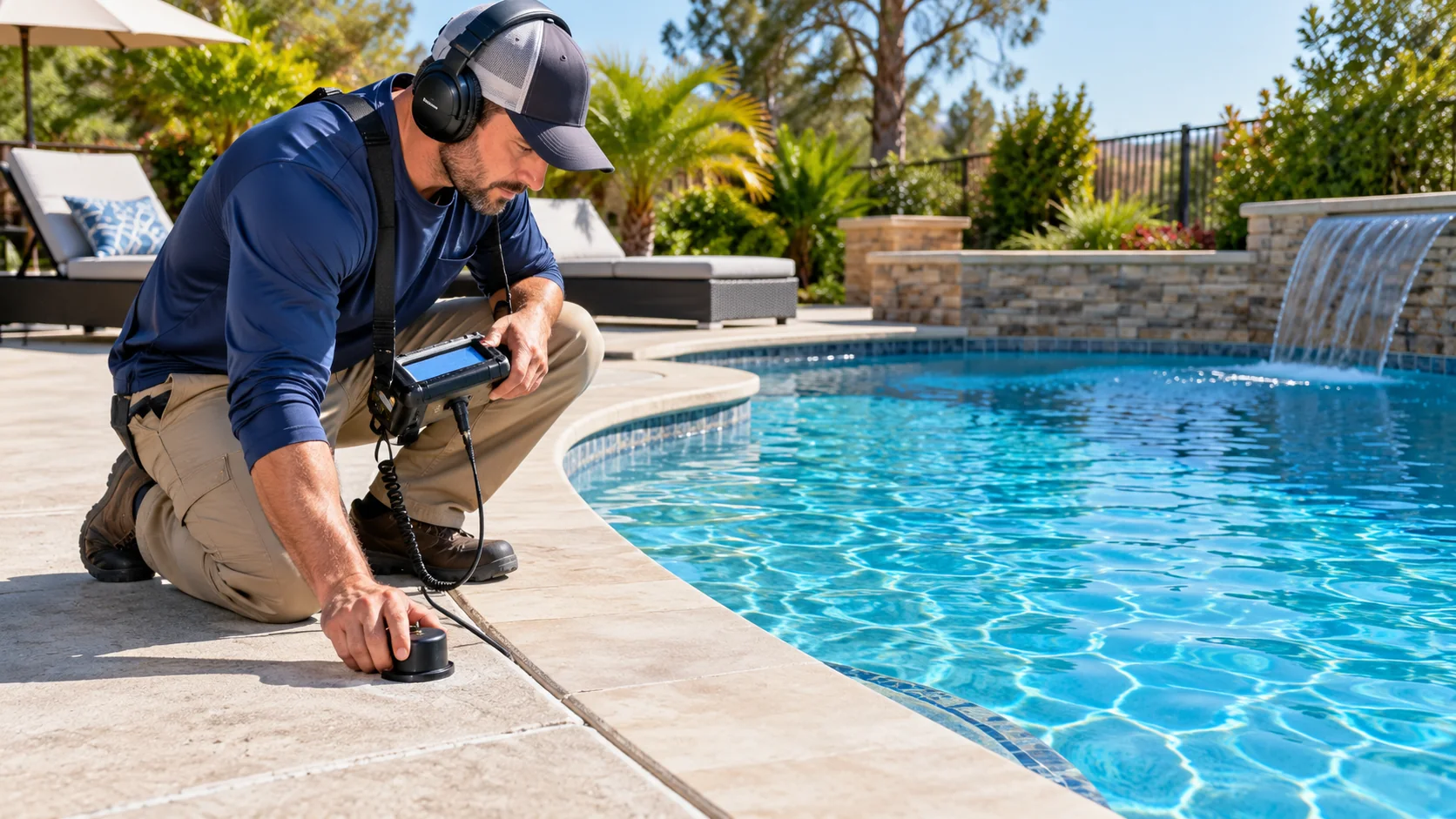
A pool leak under a concrete deck may originate in a buried suction pipe, return pipe, fitting connection or another section of underground plumbing. Because these components are concealed, the first visible symptom may be repeated water loss rather than an obvious broken pipe. Moisture beneath or beside the deck can also come from irrigation, stormwater or another utility system.
Finding the source before removing concrete is important. Breaking open the wrong part of a deck adds restoration costs without solving the original problem. Professional leak detection uses a sequence of tests to identify the affected system and narrow the area that may require access.
Plan a detection budget, then compare relevant specialists before authorizing repairs.
Warning Signs of an Underground Pool Leak
Persistent water loss is one of the most useful starting observations. A pool that needs frequent refilling may have an underground problem, but water loss alone cannot establish where it is occurring. Compare it with evaporation before assuming that hidden plumbing is responsible.
Other clues can include persistently wet ground near the equipment pad, unexpected soil movement or moisture appearing along a probable pipe route. Cracking or settlement around a deck may deserve attention, although those symptoms can have causes unrelated to pool plumbing. A damp patch is not always positioned directly above the leak.
Unusual pressure behavior, air entering the pump or water loss that changes with the circulation system can further guide an inspection. These observations help determine which circuit should be tested first. They should not be used to justify excavation without supporting evidence.
How Professionals Locate a Leak Beneath Concrete
Step 1. Confirm abnormal pool-water loss
The investigation should establish that the pool loses water beyond ordinary evaporation and use. The bucket test calculator can help organize the measurements. Pump schedules, automatic filling and recent maintenance should also be documented.
Step 2. Identify the affected plumbing circuit
A technician can isolate selected plumbing lines and perform controlled pressure testing when appropriate. A circuit that does not maintain the expected test pressure may need further investigation. The result indicates a possible defective section, not automatically the precise point where the pipe is damaged.
Step 3. Narrow the location
Professional acoustic equipment can help detect sounds associated with escaping water or test media along a suspected pipe route. Other locating methods may be considered when site conditions or the pipe material make ordinary listening less effective. Background noise, pipe depth, reinforcement, soil and deck construction can all affect accuracy.
Step 4. Plan access and repair
Only after sufficient evidence has been collected should the contractor recommend a specific access point. Some repairs may involve targeted concrete cutting and pipe replacement, while others may require an alternative pipe route. The homeowner should understand both the plumbing work and the restoration required afterward.
Can a Pool Leak Be Repaired Without Breaking Concrete?
Sometimes, but not always. An accessible fitting or equipment connection may be repaired without deck excavation. A buried damaged pipe may require access, although routing and repair options depend on the system layout.
No responsible assessment should promise a completely noninvasive repair before the failure is located and evaluated. The better objective is to minimize unnecessary damage while addressing the confirmed cause. A well-defined inspection can help determine whether deck removal is genuinely required.
What Determines the Cost?
The total price can include diagnostic labor, specialized testing, access work, pipe repair, materials and deck restoration. The costs are different for a readily accessible connection and a deeply buried line beneath reinforced concrete. Landscaping, permits or matching an existing decorative finish may add further complexity.
When comparing contractors, ask for separate amounts for leak location, excavation, plumbing repairs and restoration. Confirm whether the person who repairs the pipe will also restore the deck. Request a written process for handling additional damage discovered after access begins.
Questions to Ask Before Authorizing Excavation
A useful contractor proposal should explain which plumbing circuit failed testing and how the repair location was selected. It should describe the confidence and limitations of the locating process, the planned opening and any alternative approaches. The contractor should also explain what happens if the suspected break is not found at the first access point.
After repair, ask for confirmation that the affected system has been tested and that abnormal pool-water loss has been reassessed. Preserve inspection reports and photographs for future maintenance. These records can be useful if the deck or surrounding soil requires monitoring afterward.
Do not approve exploratory demolition without understanding the evidence.
Estimate Pool Leak Detection Cost – Explore the inspection factors that can affect the initial budget.
Find a Pool Leak Specialist – Compare companies advertising underground pool plumbing detection.
Frequently Asked Questions
How can you find a pool leak under concrete without digging?
Specialists may combine plumbing isolation, controlled pressure testing and acoustic locating. These methods can narrow the suspected location before excavation.
Does wet concrete always mean a pool pipe is leaking?
No. Irrigation, drainage, groundwater and other systems may cause moisture around a deck.
Can a broken underground return line affect pool water levels?
Yes. A defective return line may release water into the surrounding ground, sometimes more noticeably during circulation.
Does pool leak detection include concrete repair?
Not necessarily. Ask whether access work, plumbing repair and deck restoration are included in the same estimate.