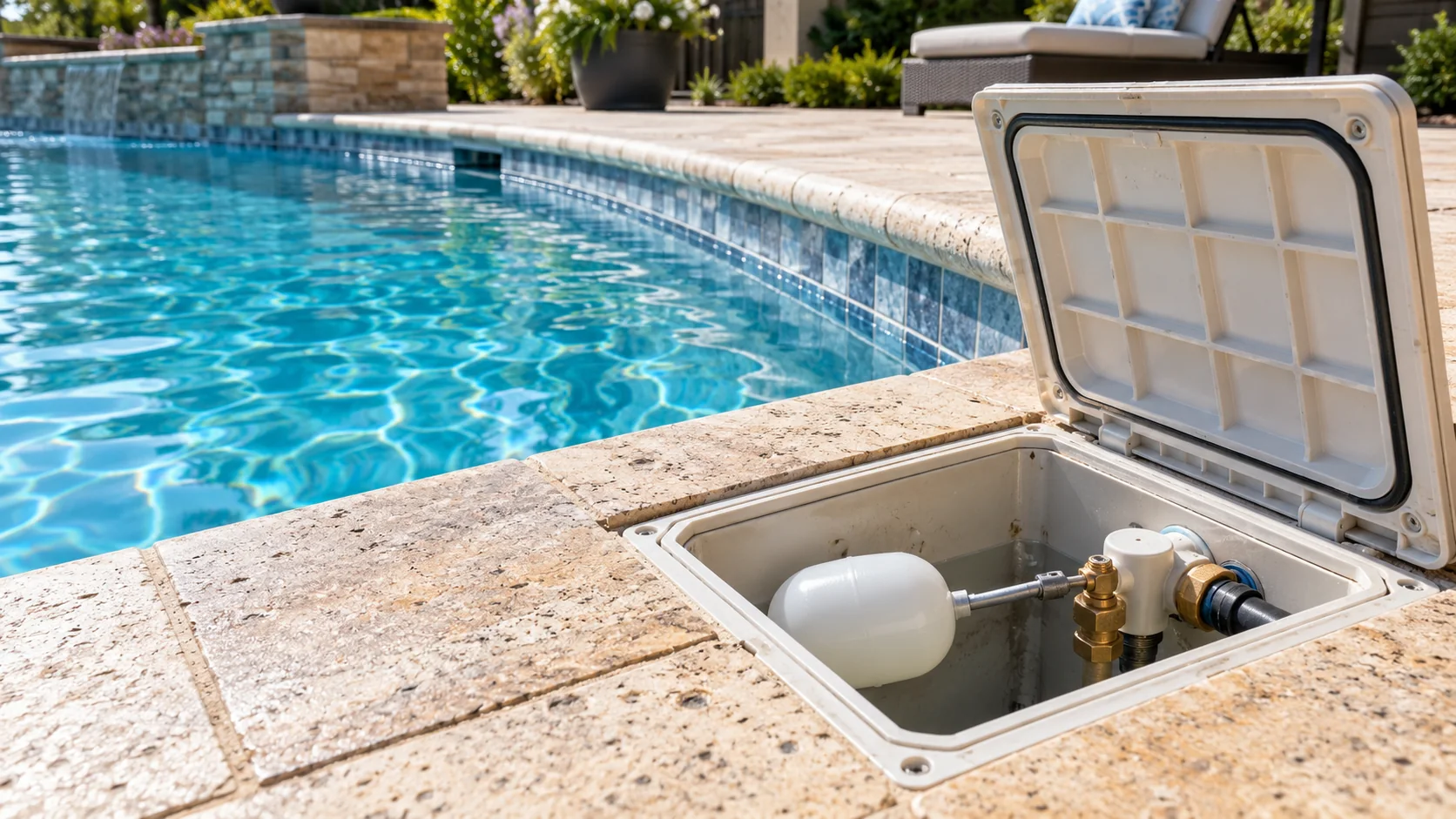
When a pool autofill keeps running, the pool may be losing water faster than the system can replace it, or the automatic fill device may be malfunctioning. An autofill maintains the water level by allowing fresh water into the pool when the level drops. This convenience makes abnormal water use harder to notice.
The problem can originate in several places: the pool itself, the float valve, the water supply connection or the overflow arrangement. A stuck fill valve may continue supplying water even after the pool reaches its intended level. Conversely, a correctly functioning autofill may operate frequently because a genuine leak is removing water.
Plan a detection budget, then compare relevant specialists before authorizing repairs.
How an Automatic Pool Fill System Works
Many residential pools use a float-operated valve inside a small leveling chamber connected to the pool. As the pool level falls, the float moves and allows replacement water to enter. When the intended level is restored, the valve should close.
The exact arrangement differs between installations. Some systems use electronic level sensors or controls, while others have mechanical floats. Understanding which design is installed helps explain why a valve may fail or why water may continue flowing after the expected level has been reached.
Four Reasons a Pool Autofill May Run Constantly
| Possible cause | What may happen | What needs checking |
|---|---|---|
| Pool leak | Replacement water repeatedly enters the pool | Actual water loss compared with evaporation |
| Stuck fill valve | Water continues after the intended level is reached | Float movement, valve sealing and control function |
| Overflow discharge | Added water may leave through an overflow | Fill level, overflow route and valve operation |
| Supply-line defect | Water escapes before reaching the pool | Water supply piping and nearby ground conditions |
These conditions can sometimes occur together. For example, a faulty valve may raise the water level enough to trigger overflow while a separate leak continues elsewhere. A professional inspection should consider the complete water path instead of concentrating only on the float.
How to Recognize Abnormal Water Consumption
Start by observing the refill frequency and checking whether the pool level remains unusually stable despite substantial water use. A stable waterline does not prove there is no leak, because the autofill may be replacing lost water continuously. Unexplained increases in water consumption make the behavior worth investigating.
If the installation has a clearly identified and safe way to isolate automatic filling, a controlled water-loss observation may be appropriate. The exact procedure must respect the equipment design and maintain a safe operating water level. Do not bypass safety devices, cap overflow paths indiscriminately or leave the system unattended in an unsafe condition.
The PoolLeakRadar bucket test calculator can help compare water loss with evaporation after the refill system has been appropriately isolated.
Could a Stuck Valve Be the Only Problem?
Yes. A valve that fails to close can continually admit water even when the pool shell and circulation plumbing are watertight. Water may then leave through an overflow, creating wasted water and an unexpectedly high bill.
This is an important distinction because detecting a pool leak will not fix a defective fill valve. A technician should determine whether water is being lost from the pool, added unnecessarily or escaping somewhere in the supply system. The recommended repair depends on that finding.
What Should a Professional Inspect?
A useful assessment may include the valve or sensor operation, intended water level, overflow arrangement and signs of actual pool-water loss. If measurements indicate a leak, the specialist can examine pool fittings, equipment and plumbing according to the reported symptoms. A separate plumber may be needed for a defect in the household water supply connection.
Ask the contractor to describe which system is responsible for the abnormal water consumption. Confirm whether the proposed quote covers valve repair, pool leak detection or both. The written scope should avoid treating every running autofill as evidence of a damaged pool.
Why the Problem Should Not Be Ignored
Continuous water replacement can increase water bills and create unnecessary chemical demand. It may also conceal a leak for long enough that the original problem becomes harder to track through routine observations. In some locations, utility billing arrangements can make persistent water consumption particularly expensive.
A systematic diagnosis is preferable to adjusting the float repeatedly without identifying the underlying issue. Begin with the water-loss evidence, then determine whether the pool or the refill equipment is responsible.
Find out whether the problem is the valve, the pool or both.
Estimate Pool Leak Detection Cost – Plan the likely inspection budget.
Find a Pool Leak Specialist – Compare service providers and discuss the autofill symptoms.
Frequently Asked Questions
Does a constantly running autofill mean the pool has a leak?
No. A stuck valve, overflow problem or supply-line defect can cause continuous water use without a pool-shell leak.
Can an autofill hide a major pool leak?
Yes. Continuous replacement water can maintain a normal-looking pool level while substantial water is being lost.
Should the autofill run every day?
There is no universal acceptable schedule. Climate, evaporation, pool use and system design affect refill demand, but unexplained continuous operation warrants investigation.
Can a pool leak specialist repair an autofill valve?
Some providers can, while others focus on leak location. Ask whether valve repair and water supply work are included in the company's advertised services.